Chandler AZ Home Prices by Neighborhood in 2026
September 17, 2026
September 17, 2026
Picture two Saturday open houses in Chandler this summer, ten minutes apart. The first is a resale in Fulton Ranch, priced against neighborhood comps, the seller unwilling to budge below asking. The second is a new-construction spec home near the Price Road corridor, same square footage, same price bracket on paper, and the builder is already offering a rate buydown before the first walkthrough. Same city. Same season. Two sellers behaving like they're in different markets.
They are. That's the story the citywide median can't tell you.
Every portal and market report this year has a number for "the Chandler market." Ask three of them and you'll get three different answers. One tracker had the median sale price at $520,000 for the three months ending in May 2026, down 2.9 percent from the year before. Another, pulling straight from the Arizona MLS, put the median list price at $559,900 as of mid-July 2026. A third had June 2026's median sale price at $568,900. None of these sources is wrong. They're measuring different slices of a market that has split into pieces that no longer move together, and the citywide median is just the average of pieces that disagree.
Local market analysis this year has started separating Chandler into price tiers, and the split explains why the "median" feels like it's describing someone else's house.
At the bottom sits an entry tier, generally below $450,000, concentrated in attached housing and Chandler's northern corridors. Inventory here is thin and a clean, move-in-ready home still draws steady attention from buyers tired of renting.
The middle is the largest slice by far: roughly $450,000 to $750,000, the traditional single-family stock that makes up most of Chandler's everyday transaction volume. One recent read on this tier put the typical single-family sale around $550,000, describing it as a healthy step down from the peak years rather than a market in trouble.
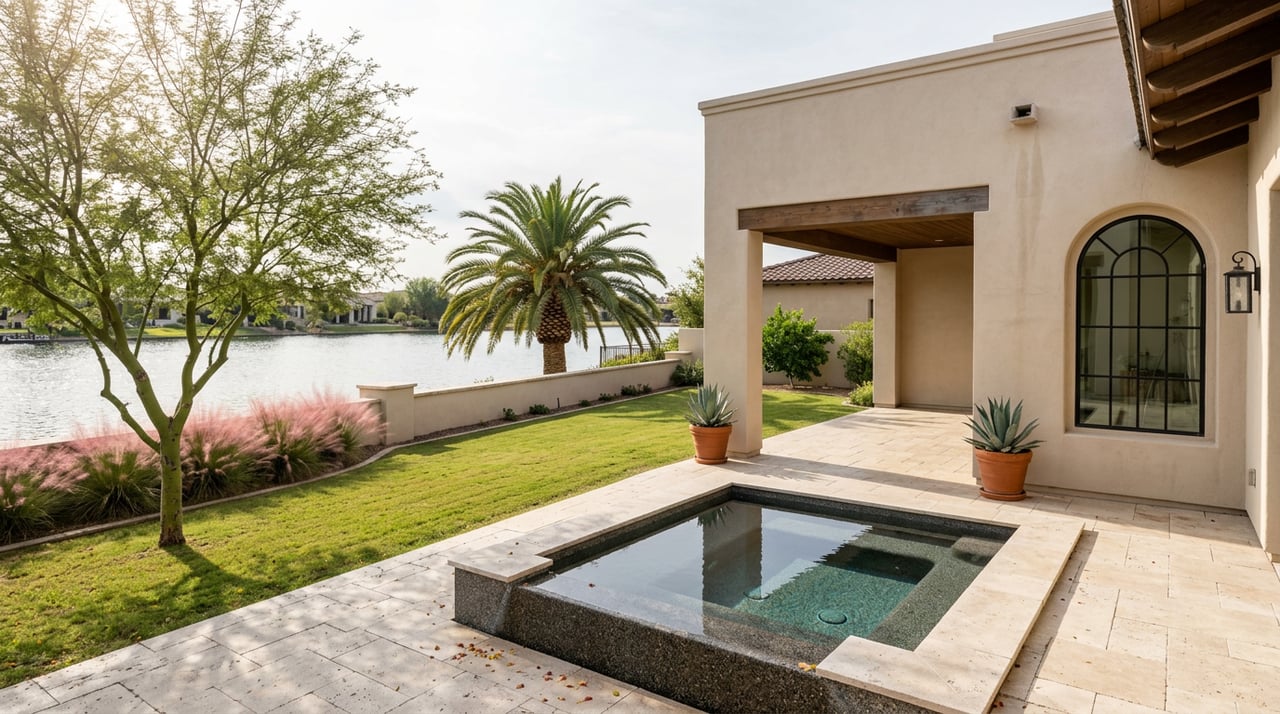
Above $750,000, the character changes again. This is where Chandler's lakefront and master-planned communities live. Ocotillo's median sits close to $749,000. South Chandler, home to Fulton Ranch, runs close to $725,000. These aren't just pricier versions of the middle tier. They're a different product entirely, built around water features, larger lots, and buyers who are typically moving up rather than moving in for the first time.
Here's what that looks like when you actually put it side by side:
| Tier | Approximate range | Where you'll find it | What you're actually buying |
|---|---|---|---|
| Entry | Under $450,000 | Northern corridors, attached housing | Condos, townhomes, limited single-family inventory |
| Heart of the market | $450,000 to $750,000 | Central Chandler, most subdivisions | Traditional single-family homes, the bulk of sales |
| Luxury / lakefront | $750,000 and up | Ocotillo, Fulton Ranch, South Chandler | Larger lots, water features, move-up buyers |
Blend all three into one number and you get a median that doesn't describe the entry buyer's condo or the Ocotillo move-up buyer's lakefront lot. It describes an average of both, which is a house that doesn't exist.
There's a second layer to this, and it's the one that explains the two open houses from the top of this post.
Zoom out to Maricopa County, where Chandler sits alongside Gilbert, Mesa, and the rest of the East Valley in the same regional data, and a pattern shows up that doesn't get much attention: new construction has been losing ground to resale homes all year. In June 2026, new homes made up about 15.8 percent of the county's closed sales, down from roughly 20.8 percent the year before, a drop of more than five percentage points. Earlier in the spring that share dipped as low as 15.3 percent, the lowest reading since April 2022. Pricing tells the same story. New-home prices fell around 3.4 percent year over year during this stretch, while resale prices actually climbed about 1.1 percent.
This matters in Chandler specifically because so much of the county's active building sits in exactly the corridors that also carry the city's biggest price tag: the Price Road corridor near the Loop 101 and Loop 202 interchange, and the newer phases of Fulton Ranch and Ocotillo. Those are the addresses where a buyer is most likely to be cross-shopping a builder's spec home against a resale two streets over, and where the builder is the one losing the pricing argument this year.
That's the mechanism behind the open house scenario. The resale seller in Fulton Ranch is pricing against other resales, where demand has held up and prices have inched higher. The builder down the street is competing against a countywide retreat in new-home demand, and discounting to keep pace. Two homes, same price bracket, same zip code, responding to entirely different pressure.
A citywide days-on-market number can't tell you whether you're watching a resale market that's holding steady or a new-construction segment that's actively retreating. It can only tell you the average of both.
The tier and the construction type both change what you should expect to see, so the questions worth asking shift depending on where you're looking.
The same fracture works in reverse for sellers. Pricing a resale against "the Chandler median" ignores which of the three tiers you're actually in and whether new construction is quietly discounting nearby.
A seller in the $450,000 to $750,000 tier who prices against last year's number rather than the last 60 to 90 days of closed comps is the seller whose listing sits long enough to need a cut. With overall days on market this year ranging from the high 40s to the high 70s depending on the source and month, timing your list date around actual recent comps, not a citywide headline, is the difference between selling on schedule and chasing the market down in price reductions.
A seller in Ocotillo or Fulton Ranch has a different problem: knowing whether you're competing against other resales or against a builder actively cutting prices to close out unsold spec inventory two lots away. That's not something a portal's citywide chart will show you. It's something you find by looking at what's actually active and pending in your specific pocket of the city right now.
Why do different sites show different medians for the same month in Chandler? They're measuring different things. Some track closed sales over a rolling three-month window, others track active list prices on a single day, and others pull ARMLS data monthly. None of them is lying. They're all correctly describing different slices of a market that no longer moves as one thing.
Is Chandler currently a buyer's market or a seller's market? It depends heavily on tier. The entry tier still favors sellers because inventory is thin. The middle tier has shifted toward balance, with price cuts common and days on market stretching out. The luxury tier runs on its own seasonal calendar, with some sellers deliberately timing listings for early fall.
Should I compare my home's price to nearby new construction? Yes, and closely. If a builder within a mile of your resale is offering rate buydowns or price cuts to move spec inventory, that builder is effectively setting a ceiling on what a buyer will pay for a comparable resale, whether or not your own comps show it yet.
Chandler's median price is a real number. It's just not describing any specific house for sale right now, and treating it like a single market instead of at least three overlapping ones is how buyers overpay in the wrong tier and sellers underprice in the right one.
If you want a read on your specific pocket of Chandler, not the citywide average, Daniel Birk and the Birk Realtors team pull the actual comps for your street and tier. Get Your Free Home Valuation and see what the market is really doing where you are.
Stay up to date on the latest real estate trends.


Get assistance in determining current property value, crafting a competitive offer, writing and negotiating a contract, and much more. Contact us today.